can't draw can i still do 3d animation

An example of computer animation which is produced from the "motion capture" technique
Estimator animation is the procedure used for digitally generating animated images. The more general term computer-generated imagery (CGI) encompasses both static scenes and dynamic images, while computer animation only refers to moving images. Modernistic computer animation ordinarily uses 3D reckoner graphics to generate a iii-dimensional moving-picture show, although 2d figurer graphics are still used for stylistic, low bandwidth, and faster real-time renderings. Sometimes, the target of the animation is the calculator itself, but sometimes movie as well.
Computer animation is essentially a digital successor to stop motion techniques, merely using 3D models, and traditional animation techniques using frame-by-frame animation of 2D illustrations. Estimator-generated animations can also allow a unmarried graphic artist to produce such content without the use of actors, expensive set pieces, or props. To create the illusion of motility, an paradigm is displayed on the computer monitor and repeatedly replaced past a new prototype that is similar to it but avant-garde slightly in time (unremarkably at a rate of 24, 25, or thirty frames/second). This technique is identical to how the illusion of movement is achieved with idiot box and motion pictures.
For 3D animations, objects (models) are built on the computer monitor (modeled) and 3D figures are rigged with a virtual skeleton. For second effigy animations, separate objects (illustrations) and separate transparent layers are used with or without that virtual skeleton. And then the limbs, eyes, oral fissure, apparel, etc. of the figure are moved by the animator on key frames. The differences in appearance between fundamental frames are automatically calculated by the computer in a process known as tweening or morphing. Finally, the animation is rendered.[1]
For 3D animations, all frames must be rendered after the modeling is complete. For 2D vector animations, the rendering process is the key frame analogy process, while tweened frames are rendered equally needed. For pre-recorded presentations, the rendered frames are transferred to a different format or medium, similar digital video. The frames may also be rendered in real time every bit they are presented to the stop-user audience. Low bandwidth animations transmitted via the internet (e.grand. Adobe Wink, X3D) often use software on the cease-user'southward computer to render in real time as an alternative to streaming or pre-loaded high bandwidth animations.
Explanation [edit]
To trick the eye and the brain into thinking they are seeing a smoothly moving object, the pictures should be drawn at around 12 frames per second or faster.[2] (A frame is one consummate epitome.) With rates above 75-120 frames per second, no improvement in realism or smoothness is perceivable due to the way the heart and the brain both procedure images. At rates beneath 12 frames per second, most people can detect jerkiness associated with the cartoon of new images that detracts from the illusion of realistic movement.[3] Conventional hand-drawn cartoon animation often uses 15 frames per second in order to save on the number of drawings needed, just this is usually accepted because of the stylized nature of cartoons. To produce more realistic imagery, computer animation demands college frame rates.
Films seen in theaters in the United states run at 24 frames per second, which is sufficient to create the illusion of continuous move. For high resolution, adapters are used.
History [edit]
Early digital estimator animation was developed at Bong Telephone Laboratories in the 1960s by Edward E. Zajac, Frank Westward. Sinden, Kenneth C. Knowlton, and A. Michael Noll.[four] Other digital animation was as well practiced at the Lawrence Livermore National Laboratory.[5]
In 1967, a computer animation named "Hummingbird" was created by Charles Csuri and James Shaffer.[6] In 1968, a computer animation called "Kitty" was created with BESM-4 by Nikolai Konstantinov, depicting a cat moving around.[7] In 1971, a estimator animation chosen "Metadata" was created, showing various shapes.[eight]
An early stride in the history of figurer blitheness was the sequel to the 1973 flick Westworld, a science-fiction film about a society in which robots live and work among humans.[9] The sequel, Futureworld (1976), used the 3D wire-frame imagery, which featured a reckoner-animated hand and face both created by Academy of Utah graduates Edwin Catmull and Fred Parke.[ten] This imagery originally appeared in their student picture A Computer Animated Hand, which they completed in 1972.[xi] [12]
Developments in CGI technologies are reported each year at SIGGRAPH,[13] an annual briefing on estimator graphics and interactive techniques that is attended by thousands of estimator professionals each year.[14] Developers of computer games and 3D video cards strive to accomplish the same visual quality on personal computers in real-time as is possible for CGI films and animation. With the rapid advocacy of real-time rendering quality, artists began to utilize game engines to render non-interactive movies, which led to the fine art form Machinima.
Picture and goggle box [edit]
"Spring", a 3D animated curt film made using Blender
CGI short films have been produced every bit independent animation since 1976.[15] Early examples of feature films incorporating CGI animation include the live-action films Star Trek II: The Wrath of Khan and Tron (both 1982),[sixteen] [17] and the Japanese anime film Golgo 13: The Professional (1983).[18] VeggieTales is the start American fully 3D computer animated serial sold directly (made in 1993); its success inspired other animation series, such as ReBoot (1994) and Transformers: Beast Wars (1996) to prefer a fully figurer-generated style.
The first full length figurer animated television series was ReBoot,[xix] which debuted in September 1994; the series followed the adventures of characters who lived inside a estimator.[xx] The get-go feature-length computer animated film is Toy Story (1995), which was fabricated past Disney and Pixar:[21] [22] [23] following an adventure centered around anthropomorphic toys and their owners, this groundbreaking film was also the first of many fully reckoner-animated movies.[22]
The popularity of computer animation (especially in the field of special effects) skyrocketed during the modern era of U.S. animation.[24] Films similar Avatar (2009) and The Jungle Book (2016) utilize CGI for the majority of the film runtime, but yet incorporate human actors into the mix.[25] Calculator animation in this era has accomplished photorealism, to the point that estimator blithe films such as The Lion King (2019) are able to exist marketed as if they were live-action.[26] [27]
Animation methods [edit]
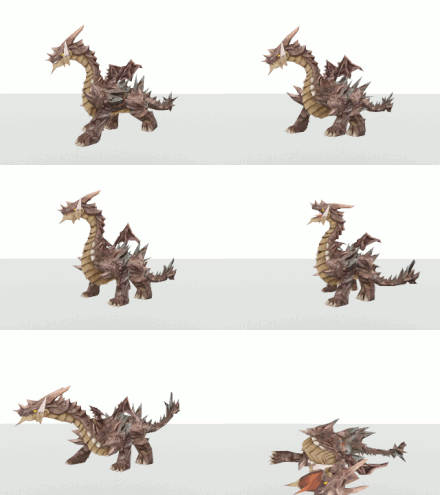

In most 3D calculator animation systems, an animator creates a simplified representation of a character's anatomy, which is analogous to a skeleton or stick figure.[28] They are arranged into a default position known as a bind pose, or T-Pose. The position of each segment of the skeletal model is defined by animation variables, or Avars for brusk. In human and beast characters, many parts of the skeletal model correspond to the actual bones, just skeletal animation is also used to animate other things, with facial features (though other methods for facial animation exist).[29] The character "Woody" in Toy Story, for case, uses 700 Avars (100 in the face lone). The computer doesn't usually render the skeletal model directly (it is invisible), only information technology does apply the skeletal model to compute the exact position and orientation of that certain character, which is somewhen rendered into an image. Thus by changing the values of Avars over time, the animator creates motion past making the character movement from frame to frame.
At that place are several methods for generating the Avar values to obtain realistic motility. Traditionally, animators manipulate the Avars directly.[xxx] Rather than gear up Avars for every frame, they commonly set Avars at strategic points (frames) in time and let the reckoner interpolate or tween betwixt them in a process called keyframing. Keyframing puts control in the hands of the animator and has roots in paw-drawn traditional blitheness.[31]
In dissimilarity, a newer method chosen motion capture makes employ of live action footage.[32] When computer animation is driven by motion capture, a real performer acts out the scene as if they were the character to exist animated.[33] Their motion is recorded to a computer using video cameras and markers and that performance is then applied to the blithe character.[34]
Each method has its advantages and as of 2007, games and films are using either or both of these methods in productions. Keyframe blitheness can produce motions that would be difficult or impossible to act out, while motion capture can reproduce the subtleties of a particular histrion.[35] For instance, in the 2006 film Pirates of the Caribbean: Expressionless Man's Breast, Bill Nighy provided the performance for the character Davy Jones. Even though Nighy doesn't appear in the motion-picture show himself, the pic benefited from his performance by recording the nuances of his body linguistic communication, posture, facial expressions, etc. Thus movement capture is appropriate in situations where believable, realistic behavior and activity is required, but the types of characters required exceed what can be done throughout the conventional costuming.
Modeling [edit]
3D computer animation combines 3D models of objects and programmed or paw "keyframed" move. These models are constructed out of geometrical vertices, faces, and edges in a 3D coordinate arrangement. Objects are sculpted much like real clay or plaster, working from general forms to specific details with various sculpting tools. Unless a 3D model is intended to be a solid color, it must exist painted with "textures" for realism. A bone/joint animation system is set to deform the CGI model (e.g., to make a humanoid model walk). In a process known as rigging, the virtual marionette is given diverse controllers and handles for controlling motility.[36] Animation data tin can exist created using move capture, or keyframing by a human animator, or a combination of the two.[37]
3D models rigged for animation may contain thousands of control points — for example, "Woody" from Toy Story uses 700 specialized animation controllers. Rhythm and Hues Studios labored for ii years to create Aslan in the flick The Chronicles of Narnia: The Lion, the Witch and the Wardrobe, which had well-nigh ane,851 controllers (742 in the face alone). In the 2004 film The Day Later on Tomorrow, designers had to design forces of extreme weather with the help of video references and authentic meteorological facts. For the 2005 remake of Male monarch Kong, actor Andy Serkis was used to assist designers pinpoint the gorilla's prime number location in the shots and used his expressions to model "human" characteristics onto the beast. Serkis had earlier provided the vocalism and performance for Gollum in J. R. R. Tolkien's The Lord of the Rings trilogy.
Equipment [edit]
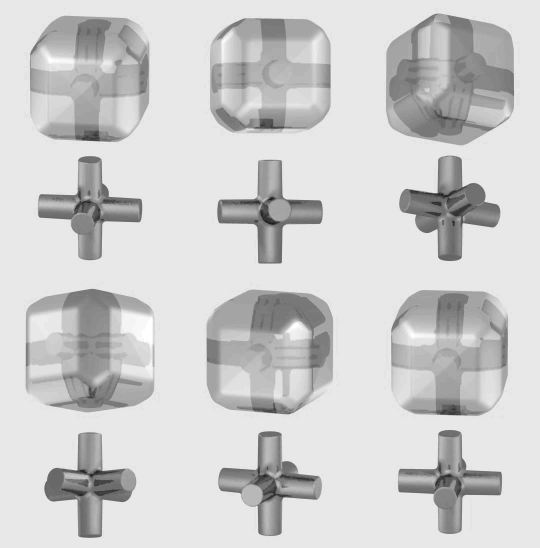
A ray-traced three-D model of a jack inside a cube, and the jack alone below.
Calculator animation can be created with a reckoner and an blitheness software. Some impressive blitheness can be achieved even with basic programs; however, the rendering tin crave much time on an ordinary home computer.[38] Professional animators of movies, television and video games could make photorealistic blitheness with loftier detail. This level of quality for movie animation would take hundreds of years to create on a habitation computer. Instead, many powerful workstation computers are used.[39] Graphics workstation computers use ii to 4 processors, and they are a lot more powerful than an bodily home reckoner and are specialized for rendering. Many workstations (known as a "render subcontract") are networked together to finer human action as a behemothic computer,[40] resulting in a computer-animated pic that can be completed in nearly one to five years (however, this process is non composed solely of rendering). A workstation typically costs $ii,000-xvi,000 with the more expensive stations being able to return much faster due to the more technologically-avant-garde hardware that they contain. Professionals also use digital movie cameras, movement/performance capture, bluescreens, picture show editing software, props, and other tools used for flick animation. Programs similar Blender allow for people who tin't afford expensive animation and rendering software to be able to work in a similar manner to those who use the commercial grade equipment.[41]
Facial animation [edit]
The realistic modeling of human facial features is both one of the near challenging and sought later elements in calculator-generated imagery. Computer facial animation is a highly complex field where models typically include a very large number of blitheness variables.[42] Historically speaking, the first SIGGRAPH tutorials on State of the fine art in Facial Animation in 1989 and 1990 proved to exist a turning point in the field past bringing together and consolidating multiple research elements and sparked involvement among a number of researchers.[43]
The Facial Action Coding System (with 46 "activity units", "lip bite" or "squint"), which had been adult in 1976, became a popular footing for many systems.[44] As early as 2001, MPEG-4 included 68 Face Animation Parameters (FAPs) for lips, jaws, etc., and the field has made pregnant progress since then and the utilise of facial microexpression has increased.[44] [45]
In some cases, an affective space, the PAD emotional country model, can exist used to assign specific emotions to the faces of avatars.[46] In this approach, the PAD model is used as a high level emotional infinite and the lower level space is the MPEG-4 Facial Animation Parameters (FAP). A mid-level Partial Expression Parameters (PEP) space is then used to in a two-level construction – the PAD-PEP mapping and the PEP-FAP translation model.[47]
Realism [edit]
Joy & Heron - A typical example of realistic blitheness
Realism in estimator animation can mean making each frame look photorealistic, in the sense that the scene is rendered to resemble a photo or make the characters' animation conceivable and lifelike.[48] Computer blitheness can too be realistic with or without the photorealistic rendering.[49]
Ane of the greatest challenges in reckoner animation has been creating human being characters that look and move with the highest degree of realism. Role of the difficulty in making pleasing, realistic human characters is the uncanny valley, the concept where the human audience (upward to a point) tends to have an increasingly negative, emotional response equally a human replica looks and acts more and more man. Films that have attempted photorealistic human characters, such as The Polar Express,[l] [51] [52] Beowulf,[53] and A Christmas Ballad [54] [55] accept been criticized as "disconcerting" and "creepy".
The goal of computer animation is not e'er to emulate live action as closely as possible, so many animated films instead feature characters who are anthropomorphic animals, legendary creatures and characters, superheroes, or otherwise take non-realistic, drawing-similar proportions.[56] Calculator animation can also be tailored to mimic or substitute for other kinds of animation, like traditional stop-motion animation (as shown in Flushed Away or The Peanuts Movie). Some of the long-standing bones principles of animation, similar squash & stretch, telephone call for movement that is not strictly realistic, and such principles still come across widespread application in computer animation.[57]
Animation studios [edit]
Some notable producers of computer-animated feature films include:
- Animal Logic – Films include Happy Feet (2006), Fable of the Guardians: The Owls of Ga'Hoole (2010), Walking with Dinosaurs (2013), The Lego Movie (2014)
- Aardman Animations – Films include Flushed Away (2006), Arthur Christmas (2011)
- Big Idea Entertainment – Jonah: A VeggieTales Movie (2002) and The Pirates Who Don't Do Anything: A VeggieTales Pic (2008)
- Bron Studios – Films include The Addams Family unit (2019), The Willoughbys (2020)
- Blue Sky Studios – Films include Ice Age (2002), Robots (2005), Horton Hears a Who! (2008), Rio (2011), Epic (2013), The Peanuts Picture show (2015)
- Dna Productions – Films include Jimmy Neutron: Boy Genius (2001), Santa vs. the Snowman 3D (2002) and The Ant Not bad (2006)
- DNEG - Films includes Ron's Gone Wrong (2021)
- DreamWorks Animation – Films include Shrek (2001), Shark Tale (2004), Republic of madagascar (2005), Over the Hedge (2006), Bee Moving picture (2007), Kung Fu Panda (2008), Monsters vs. Aliens (2009), How to Train Your Dragon (2010), Rise of the Guardians (2012), The Croods (2013), Trolls (2016), The Dominate Baby (2017)
- ImageMovers – Films include The Polar Limited (2004), Monster House (2006), Beowulf (2007), A Christmas Carol (2009), Mars Needs Moms (2011)
- Ilion Blitheness Studios — Films include Planet 51 (2009), Mortadelo and Filemon: Mission Implausible (2014) Wonder Park (2019)
- Illumination — Films include Despicable Me (2010), The Lorax (2012), Minions (2015), The Secret Life of Pets (2016), Sing (2016), The Grinch (2018), The Secret Life of Pets 2 (2019)
- Industrial Light & Magic – Films include Rango (2011) and Strange Magic (2015)
- Pacific Data Images – Films include Antz (1998), Shrek (2001), Shrek 2 (2004), Madagascar (2005), Megamind (2010), Mr. Peabody and Sherman (2014)
- Paramount Animation – Films include The SpongeBob Movie: Sponge Out of Water (2015), Monster Trucks (2017), Sherlock Gnomes (2018), Wonder Park (2019), The SpongeBob Movie: Sponge on the Run (2020; 2021)
- Pixar Animation Studios – Films include Toy Story (1995), Monsters, Inc. (2001), Finding Nemo (2003), The Incredibles (2004), Cars (2006), Ratatouille (2007), WALL-E (2008), Up (2009), Inside Out (2015), Coco (2017), and Soul (2020)
- Rainmaker Studios – Films include Escape from Planet Earth (2013) and Ratchet & Clank (2016)
- Reel FX Animation Studios – Films include Free Birds (2013) and The Book of Life (2014)
- Wizart Animation – Films include The Snow Queen (2012), Sheep and Wolves (2016)
- Shirogumi – Films include Friends: Mononoke Shima no Naki (2011), Stand by Me Doraemon (2014) and Dragon Quest: Your Story (2019)
- Square Pictures – Films include Final Fantasy: The Spirits Within (2001)
- Sony Pictures Imageworks – Films include The Angry Birds Film (2016), Sausage Party (2016), Over the Moon (2020)
- Triggerfish Blitheness Studios – Films include Zambezia (2013), Khumba (2014)
- Vanguard Animation - Films include Valiant (2005), Infinite Chimps (2008)
- Walt Disney Animation Studios – Films include Bolt (2008), Tangled (2010), Wreck-It Ralph (2012), Frozen (2013), Big Hero 6 (2014), Zootopia (2016), Moana (2016) and Raya and the Last Dragon (2021)
- Warner Animation Group – Films include The Lego Movie (2014), Storks (2016), The Lego Batman Picture show (2017), Smallfoot (2018), Scoob! (2020)
- Weta Digital – Films include The Adventures of Tintin (2011) The Pawpatrol Movie (2021) Frozen 2 (2019)
Web animations [edit]
The popularity of websites that allow members to upload their ain movies for others to view has created a growing community of independent and amateur computer animators.[58] With utilities and programs oftentimes included complimentary with modernistic operating systems, many users tin can make their own blithe movies and shorts. Several gratis and open up-source animation software applications exist as well. The ease at which these animations tin be distributed has attracted professional person blitheness talent likewise. Companies such equally PowToon and Vyond endeavour to bridge the gap by giving amateurs access to professional animations every bit clip art.
The oldest (most backward compatible) web-based animations are in the animated GIF format, which can be uploaded and seen on the spider web easily.[59] Yet, the raster graphics format of GIF animations slows the download and frame charge per unit, especially with larger screen sizes. The growing demand for college quality spider web-based animations was met by a vector graphics culling that relied on the use of a plugin. For decades, Flash animations were the most pop format, until the spider web development community abandoned back up for the Flash Player plugin. Spider web browsers on mobile devices and mobile operating systems never fully supported the Flash plugin.
Past this time, cyberspace bandwidth and download speeds increased, making raster graphic animations more user-friendly. Some of the more complex vector graphic animations had a slower frame charge per unit due to complex rendering compared to some of the raster graphic alternatives. Many of the GIF and Wink animations were already converted to digital video formats, which were compatible with mobile devices and reduced file sizes via video compression technology. Withal, compatibility was still problematic as some of the popular video formats such every bit Apple'south QuickTime and Microsoft Silverlight required plugins. YouTube, the most popular video sharing website, was also relying on the Wink plugin to evangelize digital video in the Wink Video format.
The latest alternatives are HTML5 compatible animations. Technologies such as JavaScript and CSS animations made sequencing the movement of images in HTML5 web pages more convenient. SVG animations offered a vector graphic alternative to the original Flash graphic format, SmartSketch. YouTube offers an HTML5 alternative for digital video. APNG (Animated PNG) offered a raster graphic alternative to animated GIF files that enables multi-level transparency non available in GIFs.
Detailed examples and pseudocode [edit]
In 2D calculator animation, moving objects are often referred to as "sprites." A sprite is an epitome that has a location associated with it. The location of the sprite is changed slightly, between each displayed frame, to make the sprite announced to movement.[60] The post-obit pseudocode makes a sprite move from left to correct:
var int x := 0, y := screenHeight / two; while ten < screenWidth drawBackground() drawSpriteAtXY (x, y) // draw on top of the groundwork x := 10 + five // move to the right
Computer animation uses different techniques to produce animations. Near frequently, sophisticated mathematics is used to manipulate complex three-dimensional polygons, employ "textures", lighting and other furnishings to the polygons and finally rendering the consummate prototype. A sophisticated graphical user interface may exist used to create the animation and arrange its choreography. Some other technique called effective solid geometry defines objects by conducting boolean operations on regular shapes, and has the advantage that animations may be accurately produced at any resolution.
Estimator-assisted vis-à-vis computer-generated [edit]
To animate ways, figuratively, to "requite life to". There are two basic methods that animators commonly use to reach this.
Computer-assisted animation is usually classed as 2-dimensional (2D) animation. Drawings are either mitt fatigued (pencil to paper) or interactively drawn (on the computer) using different assisting appliances and are positioned into specific software packages. Within the software package, the creator places drawings into unlike primal frames which fundamentally create an outline of the most important movements.[61] The computer and then fills in the "in-between frames", a process unremarkably known as Tweening.[62] Reckoner-assisted animation employs new technologies to produce content faster than is possible with traditional animation, while still retaining the stylistic elements of traditionally drawn characters or objects.[63]
Examples of films produced using estimator-assisted animation are The Picayune Mermaid, The Rescuers Down Under, Beauty and the Animal, Aladdin, The Lion King, Pocahontas, The Hunchback of Notre Dame, Hercules, Mulan, The Road to El Dorado and Tarzan.
Figurer-generated animation is known as iii-dimensional (3D) animation. Creators design an object or character with an X, a Y and a Z centrality. No pencil-to-newspaper drawings create the mode computer-generated animation works. The object or grapheme created will and then be taken into a software. Key-framing and tweening are likewise carried out in calculator-generated animation but then are many techniques unrelated to traditional animation. Animators tin intermission concrete laws by using mathematical algorithms to cheat mass, strength and gravity rulings. Fundamentally, fourth dimension scale and quality could exist said to be a preferred fashion to produce animation as they are major aspects enhanced by using computer-generated blitheness. Another positive aspect of CGA is the fact 1 tin create a flock of creatures to act independently when created equally a grouping. An animal's fur tin be programmed to wave in the wind and lie flat when it rains instead of separately programming each strand of hair.[63]
A few examples of computer-generated animation movies are Toy Story, Antz, Water ice Age, Happy Feet, Despicable Me, Frozen, and Shrek.
See also [edit]
- Animation
- Animation database
- Autodesk
- Avar (animation variable)
- Computer-generated imagery (CGI)
- New York Constitute of Technology Computer Graphics Lab
- Figurer representation of surfaces
- Paw-Over
- Humanoid animation
- List of animation studios
- List of calculator-animated films
- Listing of computer-animated television series
- Medical animation
- Morph target animation
- Machinima (recording video from games and virtual worlds)
- Movement capture
- Procedural animation
- Ray tracing
- Rich Representation Linguistic communication
- Skeletal animation
- Timeline of reckoner blitheness in film and television receiver
- Virtual artifact
- Wire-frame model
- Twelve bones principles of animation
References [edit]
Citations [edit]
- ^ Sito 2013, p. 232.
- ^ Masson 1999, p. 148.
- ^ Parent 2012, pp. 100–101, 255.
- ^ Masson 1999, pp. 390–394.
- ^ Sito 2013, pp. 69–75.
- ^ "Charles Csuri, Fragmentation Animations, 1967 - 1970: Hummingbird (1967)". YouTube.
- ^ ""Kitten" 1968 computer animation". YouTube.
- ^ "Metadata 1971". YouTube.
- ^ Masson 1999, p. 404.
- ^ Masson 1999, pp. 282–288.
- ^ Sito 2013, p. 64.
- ^ Means 2011.
- ^ Sito 2013, pp. 97–98.
- ^ Sito 2013, pp. 95–97.
- ^ Masson 1999, p. 58.
- ^ "The First Completely Computer-Generated (CGI) Cinematic Image Sequence in a Characteristic Film (1982)". HistoryofInformation.com. Jeremy Norman & Co. Retrieved 15 June 2014.
- ^ "The Making of Tron". Video Games Actor. Vol. ane, no. ane. Carnegie Publications. September 1982. pp. 50–v.
- ^ Beck, Jerry (2005). The Blithe Movie Guide . Chicago Review Press. p. 216. ISBN1569762228.
- ^ Sito 2013, p. 188.
- ^ Masson 1999, p. 430.
- ^ Masson 1999, p. 432.
- ^ a b Masson 1999, p. 302.
- ^ "Our Story", Pixar, 1986-2013. Retrieved on 2013-02-15. "The Pixar Timeline, 1979 to Present". Pixar. Archived from the original on 2015-09-05.
- ^ Masson 1999, p. 52.
- ^ Thompson, Anne (2010-01-01). "How James Cameron's Innovative New 3D Tech Created Avatar". Popular Mechanics . Retrieved 2019-04-24 .
- ^ Fleming, Mike Jr. (October thirteen, 2016). "Disney'southward Alive-Action 'Lion King' Taps Jeff Nathanson Equally Writer". Deadline Hollywood. Archived from the original on October fifteen, 2016. Retrieved July 9, 2019.
- ^ Rottenberg, Josh (July 19, 2019). "'The Lion King': Is it animated or live-action? Information technology's complicated". Los Angeles Times . Retrieved December 13, 2021.
- ^ Parent 2012, pp. 193–196.
- ^ Parent 2012, pp. 324–326.
- ^ Parent 2012, pp. 111–118.
- ^ Sito 2013, p. 132.
- ^ Masson 1999, p. 118.
- ^ Masson 1999, pp. 94–98.
- ^ Masson 1999, p. 226.
- ^ Masson 1999, p. 204.
- ^ Parent 2012, p. 289.
- ^ Beane 2012, p. 2-xv.
- ^ Masson 1999, p. 158.
- ^ Sito 2013, p. 144.
- ^ Sito 2013, p. 195.
- ^ Foundation, Blender. "blender.org - Dwelling house of the Blender project - Free and Open 3D Cosmos Software". blender.org . Retrieved 2019-04-24 .
- ^ Masson 1999, pp. 110–116.
- ^ Parke & Waters 2008, p. xi.
- ^ a b Magnenat Thalmann & Thalmann 2004, p. 122.
- ^ Pereira & Ebrahimi 2002, p. 404.
- ^ Pereira & Ebrahimi 2002, pp. threescore–61.
- ^ Paiva, Prada & Picard 2007, pp. 24–33.
- ^ Masson 1999, pp. 160–161.
- ^ Parent 2012, pp. 14–17.
- ^ Zacharek, Stephanie (2004-11-10). "The Polar Express". Salon . Retrieved 2015-06-08 .
- ^ Herman, Barbara (2013-x-30). "The x Scariest Movies and Why They Pitter-patter United states of america Out". Newsweek . Retrieved 2015-06-08 .
- ^ Clinton, Paul (2004-eleven-10). "Review: 'Polar Express' a creepy ride". CNN . Retrieved 2015-06-08 .
- ^ Digital Actors in 'Beowulf' Are Just Uncanny – New York Times, November fourteen, 2007
- ^ Neumaier, Joe (November 5, 2009). "Apathetic, braggadocio! 'A Christmas Carol's 3-D spin on Dickens well done in parts merely lacks spirit". New York Daily News . Retrieved October 10, 2015.
- ^ Williams, Mary Elizabeth (November 5, 2009). "Disney's 'A Christmas Carol': Bah, humbug!". Salon.com. Archived from the original on January 11, 2010. Retrieved October x, 2015.
- ^ Sito 2013, p. 7.
- ^ Sito 2013, p. 59.
- ^ Sito 2013, pp. 82, 89.
- ^ Kuperberg 2002, pp. 112–113.
- ^ Masson 1999, p. 123.
- ^ Masson 1999, p. 115.
- ^ Masson 1999, p. 284.
- ^ a b Roos, Dave (2013). "How Computer Animation Works". HowStuffWorks. Retrieved 2013-02-15 .
Works cited [edit]
- Beane, Andy (2012). 3D Animation Essentials. Indianapolis, Indiana: John Wiley & Sons. ISBN978-ane-118-14748-1.
- Kuperberg, Marcia (2002). A Guide to Computer Animation: For TV, Games, Multimedia and Web. Focal Press. ISBN0-240-51671-0.
- Magnenat Thalmann, Nadia; Thalmann, Daniel (2004). Handbook of Virtual Humans. Wiley Publishing. ISBN0-470-02316-3.
- Masson, Terrence (1999). CG 101: A Computer Graphics Industry Reference. Digital Fauxtography Inc. ISBN0-7357-0046-10.
- Ways, Sean P. (December 28, 2011). "Pixar founder'southward Utah-fabricated Manus added to National Film Registry". The Salt Lake Tribune . Retrieved January 8, 2012.
- Paiva, Ana; Prada, Rui; Picard, Rosalind W. (2007). "Facial Expression Synthesis using PAD Emotional Parameters for a Chinese Expressive Avatar". Affective Computing and Intelligent Interaction. Lecture Notes in Information science. Springer Science+Business organization Media. 4738. doi:10.1007/978-3-540-74889-2. ISBN978-three-540-74888-5.
- Parent, Rick (2012). Computer Blitheness: Algorithms and Techniques. Ohio: Elsevier. ISBN978-0-12-415842-ix.
- Pereira, Fernando C. N.; Ebrahimi, Touradj (2002). The MPEG-iv Book. New Jersey: IMSC Printing. ISBN0-13-061621-iv.
- Parke, Frederic I.; Waters, Keith (2008). Computer Facial Blitheness (2nd ed.). Massachusetts: A.Grand. Peters, Ltd. ISBN978-1-56881-448-3.
- Sito, Tom (2013). Moving Innovation: A History of Estimator Animation. Massachusetts: MIT Press. ISBN978-0-262-01909-5.
External links [edit]
-
 Media related to Computer animations at Wikimedia Commons
Source: https://en.wikipedia.org/wiki/Computer_animation
0 Response to "can't draw can i still do 3d animation"
Post a Comment